
Icynene Attic Insulation in Huntington Beach: A Homeowner’s Guide
Icynene is one of the few insulation materials that intentionally lets a small amount of moisture pass through. That property makes it an excellent choice for some Huntington Beach attic assemblies and a genuinely bad fit for others, depending entirely on how your roof is built. This guide draws that line clearly so you’re not sold a premium product that doesn’t match your home. If you’d rather skip the research and talk to someone who installs Icynene, Demilec, and six other insulation systems, call (833) 715-5062 for a free estimate.
Here’s the short version: Icynene open-cell spray foam makes the most sense in unvented, conditioned attics where your ductwork and air handler live in the attic space itself. It’s a weaker recommendation for vented attics with insulation on the attic floor, and it’s flat-out wrong for low-slope roofs with a history of moisture problems. We’ll get into the building science below.
What Is Icynene and How Does It Actually Work?
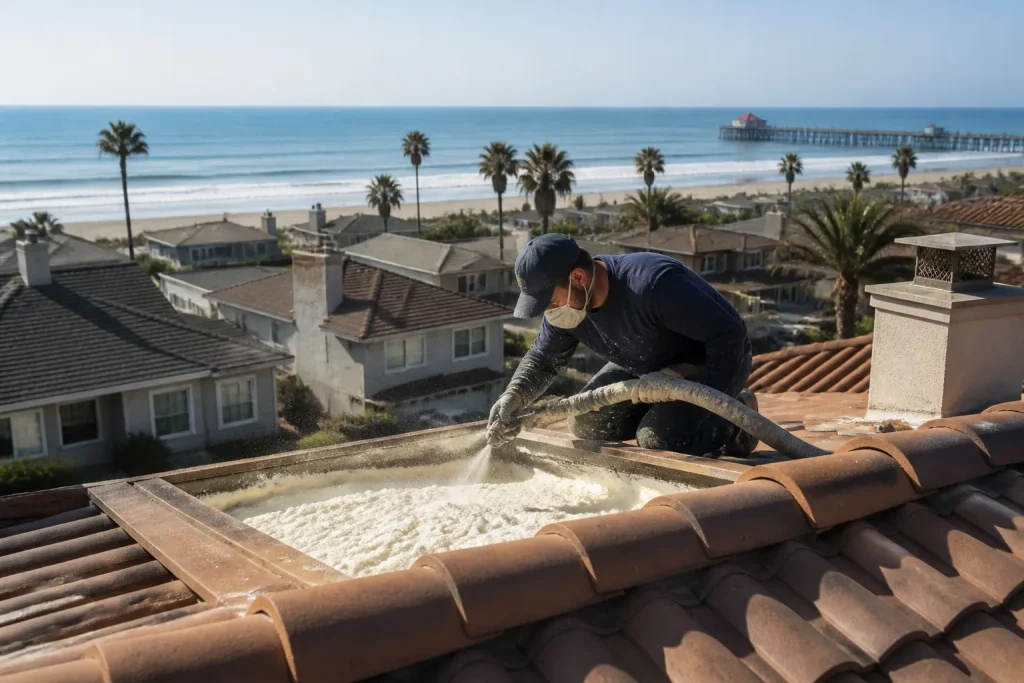
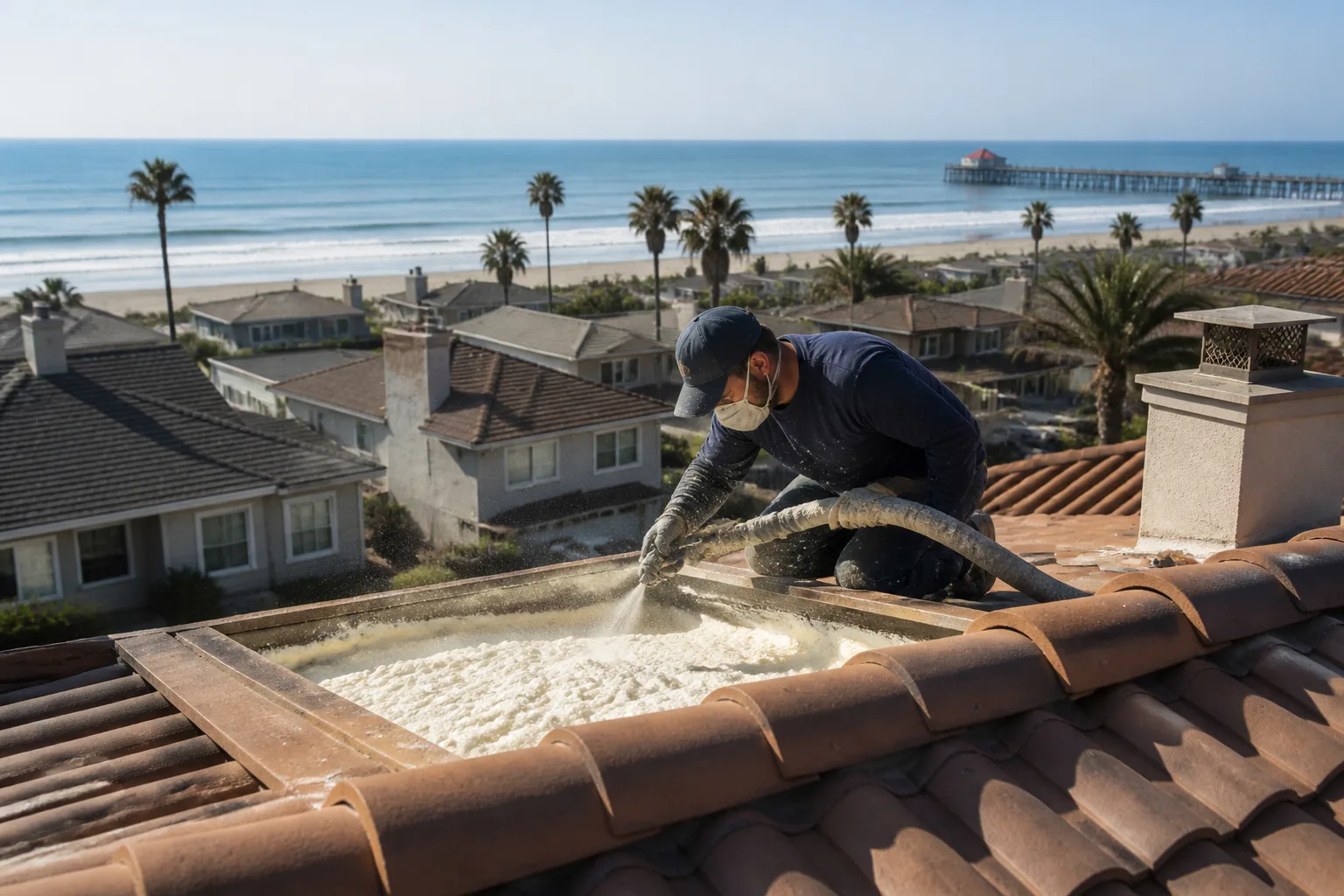
Icynene is a brand of open-cell spray polyurethane foam. When the two chemical components mix at the spray nozzle, they react and expand to roughly 100 times their liquid volume, filling every cavity, crack, and awkward gap in a roof deck or wall assembly. The cured foam is about 95 percent air by volume, which is what gives it an R-value of roughly R-3.5 to R-3.7 per inch. That’s lower per inch than closed-cell foam, but the way it performs as an air barrier is what separates it from fiberglass batts or attic insulation in Huntington Beach.
Here’s what open-cell means in practical terms: the foam’s cell walls are not fully closed, so the material is soft, spongy, and slightly vapor-permeable. Water vapor can migrate through it slowly. This is a feature, not a flaw, when the assembly is designed correctly. It’s a problem when an attic is built with materials that can’t tolerate that moisture movement.
Key numbers to keep in mind:
- R-value: roughly R-3.5 to R-3.7 per inch
- Air leakage reduction: substantial, because the foam creates a continuous monolithic air seal
- Vapor permeance: higher than closed-cell foam, which is why the assembly design matters
- Sound dampening: decent, thanks to the open air-filled cell structure
Huntington Beach sits in California climate zone 6, which means marine-influenced weather, afternoon onshore breezes, and humidity that hovers in the 60 to 75 percent range for much of the year. That coastal moisture is the single biggest reason the vented vs. unvented distinction matters so much with this product. You can learn more about our broader Spray Foam Insulation in Huntington Beach service if Icynene turns out not to be the right match.
Where Icynene Wins: Unvented Roof Decks and Conditioned Attics
In a traditional Huntington Beach home built before the 1990s, the attic is ventilated. That means soffit vents at the eaves, a ridge vent or gable vents at the top, and a big pile of insulation on the attic floor. The attic space itself is essentially outdoor air: hot in summer, cool in winter, and humid all year. Your ductwork sits in that unconditioned space, losing heating and cooling energy to air that your HVAC system never actually gets credit for conditioning.
Icynene changes the game when you apply it to the underside of the roof deck instead of the attic floor. The foam seals the roofline, moving the home’s thermal boundary to the roof plane. The attic becomes conditioned space. Ductwork, air handler, and anything else up there now operate inside the thermal envelope, not outside it. In our experience, this is the single biggest reason Huntington Beach homeowners choose Icynene: they’ve got ducts in the attic, and those ducts are bleeding conditioned air into a space that’s 15 to 20 degrees warmer than the living area in summer.
The performance difference is meaningful:
- Duct losses drop substantially once the attic is conditioned
- Air leakage through the ceiling plane is eliminated because the foam seals the roofline continuously
- The attic stays within a few degrees of the house temperature, not 130 degrees on an August afternoon
- HVAC equipment runs less often and heats or cools the living space faster
This is where open-cell foam beats the alternatives. Blown fiberglass on the attic floor does nothing for duct losses. Rigid foam cannot seal irregular roof framing nearly as well as spray-applied foam. And among spray foams, Icynene’s open-cell structure gives it one advantage on a coastal roof: it lets the roof deck dry inward if a small amount of moisture gets behind it. More on that in the next section.
Vapor Permeance and Coastal Humidity: What the Data Actually Says
Huntington Beach’s marine layer means your roof deck sees damp air for many hours each year. From May through July, overnight temperatures drop and relative humidity spikes, and during those months the underside of a wood roof deck can reach dew point if it’s not protected. The question is what happens to that moisture.
Closed-cell spray foam is a vapor barrier. At 2 inches of thickness, it blocks moisture movement almost entirely. If water finds its way into the roof deck from a pinhole leak or gets trapped behind the foam during installation, it has no path to dry inward. The moisture stays in the wood, and over years it can support rot.
Icynene open-cell is vapor-permeable. Water vapor passes through it at a known rate, which means a roof deck that gets slightly damp behind the foam can dry into the conditioned attic space over time. In a Huntington Beach climate, this permeability is genuinely useful for roofs that shed water properly and have no recurring leak history.
But this cuts both ways. That same permeability means Icynene transmits moisture faster than closed-cell foam, so in an assembly that sees chronic wetting, water vapor migrates more readily through the foam into the attic air. If the attic has poor ventilation or the home already has elevated indoor humidity, that vapor has nowhere to go. The worst case is a slow accumulation of moisture in wood framing over many seasons.
Our general guidance for coastal Huntington Beach homes:
- Icynene open-cell is appropriate on roofs that show no signs of active leaks, rusted fasteners, or water staining
- Closed-cell foam, like the Demilec systems we install, is the better call for low-slope roofs or any roof with a history of moisture intrusion, because it acts as a waterproof and vapor-resistant barrier
- The vapor drive in a marine climate is mostly outward in winter and inward in summer, so decision-making needs to account for both directions
If you’re weighing Icynene against closed-cell foam, the decision comes down to the roof’s condition and slope. Low-slope roofs in Huntington Beach neighborhoods like Edwards Hill or South of Main may be better candidates for a closed-cell product. More information on how these systems differ is on our Spray Foam Insulation in Huntington Beach page.
Icynene Cost Per R-Value in Huntington Beach: Honest Numbers
Here’s the part most insulation contractors in Huntington Beach won’t tell you in plain English: Icynene is a premium product, and it costs like one. The installed cost per square foot typically runs $1.70 to $2.50 per board foot in the Huntington Beach market, depending on the depth specified and the complexity of the roof framing. That means a 2,000-square-foot attic sprayed to R-20 at roughly 5.5 inches of depth can land between $6,500 and $10,000.
Compare that against the other options:
- Blown fiberglass attic floor insulation in Huntington Beach: roughly $1,500 to $3,000 for the same attic, but it does nothing for duct losses
- Closed-cell spray foam: $2.50 to $4.00 per board foot, roughly 60 to 80 percent more than Icynene per board foot, with a higher R-value per inch
- Blown GreenFiber cellulose on the attic floor: comparable to fiberglass in cost, slightly better air-flow resistance
- Owens Corning fiberglass batts on the attic floor: the least expensive material, and also the least effective at stopping air leakage
The cost-per-R framing is where Icynene looks expensive, because open-cell foam provides R-3.7 per inch while closed-cell foam provides R-6.5 per inch. You need nearly twice the thickness to hit the same R-value. That’s why we don’t recommend Icynene when the goal is maximum R-value in minimum space. We recommend it when the goal is creating a conditioned attic that keeps ductwork inside the thermal boundary.
For Attic Insulation in Huntington Beach projects where full roof encapsulation doesn’t make financial sense, blown fiberglass or cellulose on the attic floor is often the better answer. The right material depends on what’s actually wrong with your attic, not on what’s in the back of the truck that week. That’s the approach we take Millbrook Insulation home, and it’s why we carry eight brands spanning every major insulation category.
When Icynene Is Not the Right Call in Huntington Beach
We’ve installed enough Icynene in Huntington Beach attics to know when to talk a homeowner out of it. There are three specific situations where it’s genuinely the wrong product, and we’re comfortable saying so.
First, low-slope roofs with a moisture history. Homes near the Bolsa Chica wetlands and some older tracts in the Oak View neighborhood have roofs with pitch angles under 3:12. These roofs dry slowly and are more susceptible to trapped moisture. Open-cell foam’s vapor permeability works against you here, because the roof deck stays wetter longer and the foam transmits that moisture into the attic. A closed-cell system like Demilec is the better recommendation for these assemblies.
Second, attics with active pest infiltration. Rats and roof rats are a real problem in Huntington Beach, particularly in neighborhoods with older citrus trees. Rodents tunnel through open-cell foam much more easily than through closed-cell foam. If your attic shows signs of droppings, nesting material, or rodent damage in the existing insulation, we’ll recommend addressing the pest issue first and then using a closed-cell product, or installing Icynene only after rodent exclusion work is complete. We pulled a rat nest out of an attic over in Yorktown last month that had destroyed three feet of fiberglass batt, and it changed the whole material conversation with that homeowner.
Third, budgets that don’t allow full encapsulation. Icynene applied to the roofline only makes sense if you’re encapsulating the entire attic. Spraying just one slope creates a thermal mismatch that can concentrate condensation at the untreated roof deck. If your budget is $3,000, blown-in insulation on the attic floor is the responsible choice. You can always add Blown In Insulation in Huntington Beach now and plan for encapsulation later.
How Icynene Installation Works: What to Expect
If you do move forward with Icynene in your Huntington Beach attic, here’s what the process actually looks like. The crew will mask off the attic access and protect any stored items. The spray gun applies the two-component foam to the roof deck, and it expands within seconds. Our installers spray in passes, building depth gradually so the foam cures evenly and doesn’t sag away from the deck.
Curing takes about 24 hours. During that window, the home is not safe for occupants because the foam releases trace gases that dissipate after curing. You’ll need to stay elsewhere for a night. This is a real consideration for Huntington Beach homeowners during the summer months, when hotel demand in the area pushes prices up. We schedule around it whenever possible.
One thing that catches homeowners off guard: Icynene changes the acoustic profile of your attic. The open-cell structure absorbs sound, so you’ll notice a reduction in rain noise on the roof during winter storms, and traffic noise from Pacific Coast Highway is dampened in attics on the east-facing slope of homes near the coast.
If your attic is being converted to living space, a conditioned attic with Icynene also improves comfort in the rooms directly below, because the ceiling plane is no longer an uninsulated boundary between you and a 130-degree attic. That’s the point of the exercise, and it’s why we tell people that spray foam at the roofline is a systems decision, not a materials decision.
When to call a pro: Spray foam installation is not a DIY project. The two-component chemistry requires calibrated equipment, proper personal protective equipment, and trained application technique to avoid off-ratio foam that never fully cures or shrinks away from the deck. An amateur spray job can ruin a roof deck. If you’re considering Icynene, have a contractor who installs it regularly evaluate your attic before you buy the material. We carry Icynene and Demilec, and we’ll tell you which one fits your roof, even if that answer is “neither.”
For related work, see our Attic Insulation in Huntington Beach and Blown In Insulation in Huntington Beach pages.
The Bottom Line
Icynene open-cell spray foam is an excellent tool for a very specific job: converting a vented attic into a conditioned attic, bringing ductwork and air handlers inside the thermal envelope, and cutting the air leakage that eats your HVAC efficiency on every Huntington Beach heat wave. Its vapor permeability is a genuine asset on properly sloped, leak-free roofs in a coastal climate, because it lets the roof deck dry inward if it ever gets damp.
It’s the wrong product for low-slope roofs with moisture history, attics with active rodent problems, and budgets that can’t support full roof-deck encapsulation. In those cases, closed-cell foam like Demilec or blown insulation on the attic floor will serve you better, and a contractor who tells you otherwise is selling a product, not a solution.
If you’re in Huntington Beach and want an honest read on whether Icynene fits your attic, Millbrook Insulation offers free estimates. We carry eight insulation brands, including Icynene, Demilec, Owens Corning, and Johns Manville, so the recommendation is based on your roof, not on our inventory. Call (833) 715-5062 to schedule a look at your attic.
Frequently Asked Questions
Installed cost typically runs $1.70 to $2.50 per board foot in Huntington Beach, which translates to roughly $6,500 to $10,000 for 2,000 square feet of roof deck sprayed to R-20. The price depends on roof pitch, framing complexity, and the depth specified. Call (833) 715-5062 for an exact quote, estimates are free.
For a properly sloped, leak-free roof in Huntington Beach, Icynene’s vapor permeability lets the roof deck dry inward if it ever gets damp, which is a real advantage in a marine climate. For low-slope roofs or any roof with moisture history, closed-cell foam is the better choice because it acts as a vapor and water barrier.
It can be, but it rarely makes sense. Open-cell foam at the attic floor costs more than blown fiberglass or cellulose and delivers comparable R-value per dollar. Icynene earns its cost when applied to the roofline, where it seals the attic and brings ducts inside the conditioned space.
Yes. The foam releases trace gases during the 24-hour curing period. You’ll need to stay out of the home overnight, which is worth planning for in Huntington Beach, where summer hotel rates near the coast are not cheap. We schedule installs to minimize disruption.
Written by the team at Millbrook Insulation, serving Huntington Beach since 2015.
Need Insulation Help?
Call Millbrook Insulation — licensed & insured, here with fast after-hours help in Huntington Beach.
(833) 715-5062