
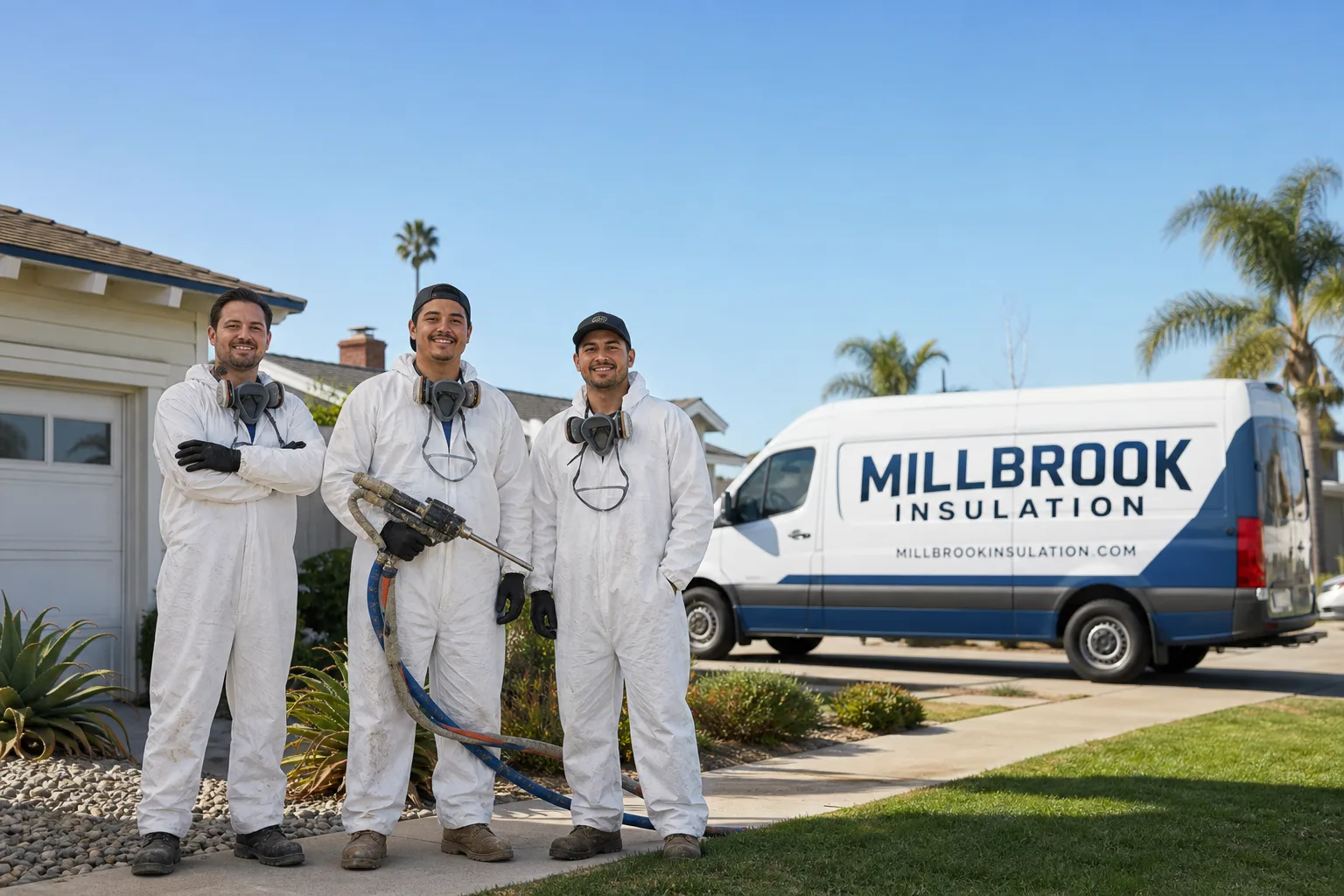
Trusted Spray Foam Insulation for Huntington Beach Homeowners
Spray Foam Insulation in Huntington Beach does two jobs at once: it seals the coastal air leaks that drive humidity into walls and attics, and it delivers an R-value per inch that fiberglass simply can’t match. We install both open-cell and closed-cell foam through our Icynene and Demilec product lines, and we choose between them based on your home’s actual conditions, not a default preference. If you’re fighting high summer cooling bills, lingering musty smells in a crawl space, or a garage that bakes every afternoon, give us a call at (833) 715-5062. Ken Albright and the Millbrook Insulation crew handle the air-sealing first, then the R-value second, because in a coastal climate like Huntington Beach, that order matters.
Closed Cell Spray Foam Insulation
Closed Cell Spray Foam Insulation is a high-density foam that cures rigid and stops both air and moisture movement, making it the right call anywhere water vapor is a threat. This is the product we turn to for Huntington Beach homes where the marine layer keeps wood framing damp for part of the year. The foam acts as a vapor barrier at about two inches thick, and at R-6.5 to R-7 per inch, it packs more thermal resistance into a smaller cavity than any other material we install. We carry two closed-cell systems, Icynene and Demilec, and we’ll match the specific formulation to your wall depth, roof deck, or crawl space condition. For unvented attic conversions and crawl space encapsulated floors, this is the most durable answer available.
Flood-Zone and Moisture-Rated Applications
Parts of Huntington Beach sit close enough to the water table that crawl spaces and ground-floor framing never fully dry out. Closed-cell foam won’t wick moisture or support mold growth, so it holds its R-value in conditions that would compress and soak fiberglass batts. That makes it our default recommendation for bolted-down coastal homes, raised foundations, and sealed crawl spaces.
Structural Air Barrier for Attics
Closed-cell foam bonds to the underside of roof decking and seals every gap, which lets you condition the attic without venting it. For Huntington Beach homeowners who want to reclaim attic square footage or stop wind-driven salt air from entering through soffit vents, this is the system we specify. It also adds racking strength to the roof assembly, a detail that matters during the winter storm season.
Open Cell Spray Foam
Open Cell Spray Foam is a lower-density, water-blown foam that expands aggressively to fill framing bays and deadens sound far better than closed-cell at about a third of the cost per board foot. We recommend it for interior walls, ceiling cavities between floors, and attic lids where the roof deck stays vented. It rates around R-3.5 per inch, so you’ll need a thicker application to hit the same thermal target as closed-cell, which is fine when we’re filling a ten-inch attic floor joist. Millbrook Insulation installs Demilec open-cell foam for these applications, and we’ll be straight with you about which foam belongs where.
Interior Sound Control
If you live near PCH, the 405, or a school drop-off line, open-cell foam inside bedroom walls and the wall between the garage and a living space changes the acoustic profile of the entire home. It absorbs sound instead of reflecting it, and the air seal it creates stops noise from flanking through outlets and baseboard gaps.
Attic Lid Air Sealing on a Budget
For a vented attic in a Huntington Beach ranch or tract home, open-cell foam at the attic floor is the most cost-efficient way to stop conditioned air from escaping through ceiling penetrations. We seal around can lights, plumbing vents, and the top plates of interior walls first, then fill. The result is a tighter envelope than fiberglass alone can provide, without the full price of a closed-cell roof deck job.
Spray Foam Insulation Contractors
Spray Foam Insulation Contractors are the trade professionals who own the specific rigs, proportioners, and training required to install two-component foam safely and correctly, and the quality gap between a good contractor and a careless one is enormous. A bad foam job off-gasses, shrinks, or fails to adhere, and fixing it means cutting the old foam out. Millbrook Insulation’s team is trained on both Icynene and Demilec application systems, and we install our own work in-house. When you hire us, you’re hiring the crew that sprays the job, not a general contractor subbing out the specialty work to the lowest bid. Ken Albright has built the crew around building science first and brand loyalty second.
What to Ask Any Contractor Before You Sign
Ask to see the foam manufacturer’s training certificate for the specific brand being sprayed. Ask whether the crew uses a proportioner with real-time temperature and pressure monitoring. Ask what their typical overspray cleanup protocol looks like for finished surfaces, because foam sticks to everything and a good contractor covers what you don’t want sprayed.
Why We Run Two Separate Spray Systems
Most crews push the one foam line their distributor sold them. We run Icynene and Demilec side by side because they behave differently at different ambient temperatures and cavity depths. The decision starts with your home’s architecture, not with which drum is already loaded on the truck.
Spray Foam Attic Insulation
Spray Foam Attic Insulation is the single highest-impact energy upgrade for most Huntington Beach homes because the attic is where the house loses the most conditioned air through the stack effect, and foam stops that airflow at the source. We install two configurations: open-cell on the attic floor for vented attics, and closed-cell under the roof deck for unvented or semi-conditioned attics. A typical spray foam attic job in Huntington Beach runs from $3,000 to $11,000 depending on square footage, foam type, and how much prep sealing the existing penetrations requires, so if you’re wondering how much Spray Foam Insulation costs, this gives you a starting point. The payoff shows up in your first summer power bill.
Unvented Attic Conversions for Coastal Bungalows
Older Huntington Beach bungalows and mid-century ranches often have attics that top 140 degrees by August. Sealing the roof deck with closed-cell foam and bringing the attic inside the home’s thermal envelope drops that number to within a few degrees of the living space. It also stops the salt-laden marine air from corroding your AC equipment and electrical connections up there.
Stopping the Soffit-Vent Leak Problem
Fiberglass batts pushed into soffit bays do nothing at the eave edge, where outside air streams in and undercuts the insulation. Foam seals the soffit transition completely, and we check the baffle configuration before we spray to make sure your roof deck still breathes correctly afterward.
Spray Foam Wall Insulation
Spray Foam Wall Insulation puts an air barrier directly inside the stud cavity, which fixes the single biggest weakness of batt insulation in exterior walls: convection through the cavity itself. In Huntington Beach, where a 20-degree day-to-night temperature swing in January drives air back and forth through unsealed walls, that convective movement is the hidden killer of comfort. We install both open-cell and closed-cell foam in walls depending on whether the wall is above grade or below, and whether we’re working from the interior during a remodel or from the exterior during re-siding. Expect wall cavity insulation to run $2 to $5 per square foot of wall area depending on foam type and cavity depth.
Remodel Additions and New Framing
When you open a wall, that’s the time to fix the air sealing. We work alongside Huntington Beach remodelers and can spray any wall before drywall goes up, including top plates, window rough openings, and the intersection of wall sheathing and floor decking. The added cost is a fraction of the total remodel and it’s the only chance to get that cavity truly tight.
Retrofit Injection into Closed Walls
For walls that aren’t being opened, we can drill and inject open-cell foam through small access holes, then patch. This works well in homes built with no wall insulation at all, or where old batts have slumped. We’ll explain the expected coverage honestly, because injection into a wall with blocking isn’t always uniform, and we’ll only recommend it where the framing lets us do the job the right way.
Rim Joist Spray Foam
Rim Joist Spray Foam is a targeted application of closed-cell foam along the perimeter band board where your floor framing meets the foundation, and it is the highest-bang-for-the-buck air sealing in a crawl space home. The rim joist is the thin piece of lumber between each floor joist end, and in a Huntington Beach home it’s often the single leakiest surface in the whole envelope. Closed-cell foam fills each joist bay with a two-inch layer that stops outside air, insects, and moisture intrusion. A full rim joist air seal in a 1,500-square-foot crawl space typically costs between $900 and $2,200 depending on access and the number of bays.
What It Fixes in a Crawl Space Home
Cold floors in winter, humidity that migrates into hardwood from below, and the damp smell that rises into the house are all rim joist symptoms. The band board runs the entire perimeter, so the number of joist bays adds up fast. We treat every bay, not just the easy reachable ones.
Combining Rim Joists with Crawl Space Encapsulation
If you’re going full encapsulation, rim joist sealing is a mandatory first step. Foaming the band board plus laying a vapor barrier on the floor changes a crawl space from a source of moisture to a dry, stable air buffer. Millbrook handles both phases so there’s one crew accountable for the air boundary being continuous.
Crawl Space Spray Foam Insulation
Crawl Space Spray Foam Insulation addresses the below-floor cavity where moisture is the dominant problem in Huntington Beach, given our shallow water table and the marine layer that keeps the soil damp nine months a year. Closed-cell foam on crawl space walls, combined with rim joist sealing, is the most effective way to stop ground moisture from rising into the home. Open-cell foam has no place in a crawl space because it absorbs water, so we use closed-cell exclusively below the floor line, which is exactly the kind of material-specific call that matters. Expect crawl space foam work to run $1,500 to $6,000 depending on whether we’re sealing just rim joists or full perimeter walls and the floor band.
Encapsulated Crawl Space Walls
Foaming the interior perimeter walls of a crawl space replaces the old vented-crawl model with a sealed, semi-conditioned space. The science is settled: vented crawl spaces in Huntington Beach’s humidity load moisture into your floor framing all summer. Sealed crawl spaces stay dryer, and sealed crawl spaces with foam insulation stay warmer in winter.
Commercial and High-Moisture Crawl Spaces
We also apply the same sealed-crawl approach to commercial spaces: converted beachfront rentals, medical offices in older Huntington Beach buildings, and any structure where a damp floor cavity threatens air quality. Closed-cell foam is the right material for those applications, and we carry two closed-cell formulations to handle different temperature and humidity conditions.
Garage Spray Foam Insulation
Garage Spray Foam Insulation turns a hot, noisy, unconditioned box into a usable space, and for a lot of Huntington Beach homes where the garage is a workshop, a gym, or a place you just don’t want to open the door and get hit by a wall of heat, it’s the single best upgrade you can make. Open-cell foam on a garage ceiling that butts up against living space stops both heat and sound transfer, and closed-cell foam on the garage walls and door headers seals the perimeter. Most garage foam jobs in our Spray Foam Insulation in Westminster and Huntington Beach run between $1,800 and $4,500 depending on whether we’re doing the ceiling only or the full envelope.
Bonus Room and ADU Prep Garages
Huntington Beach ADU conversions have exploded in the last few years, and the garage is often the starting point. Before you frame out a bedroom or office, we foam the existing wall cavities that won’t be opened up during the conversion, and we foam under the new floor if it’s above the slab. That locks the thermal boundary in before drywall goes up, and it’s far cheaper than ripping open walls later.
Sound Isolation from Garage to Home
If your garage shares a wall with a nursery, bedroom, or home office, open-cell foam in that shared wall plus the garage ceiling does what batts can’t: it seals the air gaps that let sound flank through. We also spec a Rockwool layer against the shared wall for the deepest sound reduction, because mineral wool’s density absorbs sound energy differently than foam alone.
Brands We Service
We carry Icynene spray foam for projects where a proven, widely specified open-cell and closed-cell lineup matters. Icynene’s open-cell foam is a workhorse for interior walls and attic floors, and its closed-cell formulation handles our coastal crawl space and unvented attic work. We stock the full application system and our crew has sprayed hundreds of Icynene jobs across Orange County.
For applications where the foam needs to handle specific moisture or temperature conditions, we carry Demilec. Demilec’s closed-cell foam has a formulation specifically suited to high-moisture coastal applications, and we spec it on crawl space walls and below-floor work in Huntington Beach’s damp soil zones. For mineral wool applications, we carry Rockwool, which we’ll recommend alongside or instead of Midway City Spray Foam Insulation when fire resistance or acoustic performance is the primary concern. Whether you have a specific brand in mind or you want Ken Albright to make the call based on your home’s conditions, we’ll guide you to the right material.
Signs You Need a Pro Right Now
- Condensation on attic nails or sheathing. When you see water beading on attic surfaces in winter, warm moist air from the house is leaking up and hitting cold wood. That’s a foam-sealing situation, and the longer it runs, the more likely you are to see mold or sheathing rot.
- A crawl space that smells damp after rain. Ground moisture moves upward through your floor framing all winter in Huntington Beach. If the smell rises into the house every time it rains, your rim joists and crawl space walls are moving air and moisture past whatever insulation is down there.
- One room is always 10 degrees hotter than the rest of the house. When a single room over a garage or above a crawl space won’t hold temperature, the air sealing is the problem, not the thermostat. Foam fixes the air movement that bats and blown-in materials can’t touch.
- Rising energy bills with no change in usage. If your SCE bill keeps climbing while your thermostat settings stay the same, the envelope is leaking more air every year as seals degrade. Foam is an air seal first and an insulation second.
- You hear every car that passes on PCH or Beach Boulevard. Air leaks carry sound. If outside noise comes through walls and windows even when everything is closed, the wall cavities and rim joists are almost certainly unsealed. Foam stops the air path and the sound path together.
Our Process, Step by Step
- 1
We walk the house and test the envelope. Ken or a lead installer visits your Huntington Beach home and checks the attic, crawl space, rim joists, and any existing insulation. We’re looking for air leakage paths, moisture sources, and what’s already in the cavities, because spraying over a problem doesn’t fix it.
- 2
We give you a written recommendation with options. You’ll get a specific scope of work that names the foam type, the brand, the cavity depth, and the target R-value. If closed-cell is overkill for your situation, we’ll tell you that and quote the open-cell version instead. Eight brands, one contractor: the recommendation starts with the house, not the invoice.
- 3
We prep the work area like it’s our own home. Floors get covered, finished surfaces get masked, and any existing insulation that needs to come out comes out before we spray. If we’re working in your attic, we clear a path and protect anything stored up there.
- 4
We spray in lifts, checking temperature and thickness as we go. Foam applies in passes, not one thick blast, and we monitor the ambient temperature and substrate condition throughout. Too-cold foam won’t rise, and too-hot foam won’t adhere, so we watch both constantly.
- 5
We trim, inspect every bay, and walk the job with you. After the foam cures, we cut back overspray, check every cavity for full fill, and show you what we did before we leave. You’ll know exactly which surfaces are sealed, what the final R-value is, and what to expect from your next energy bill.
How Much Does Spray Foam Insulation Cost in Huntington Beach?
A typical spray foam insulation job in Huntington Beach runs from $2,000 to $12,000, with most single-scope projects landing between $3,000 and $7,500. Rim joist sealing is at the low end, a garage ceiling is mid-range, and a full unvented attic conversion with closed-cell foam is at the high end. Square footage, foam type, cavity depth, and how much prep work the existing conditions require all move the price. The biggest cost driver is usually access: attics with low slope or limited hatch clearance means more labor, and crawl spaces with tight clearance mean more time on the crew’s back. You avoid overpaying by getting a specific scope of work that names the foam type and the area being sprayed, not just a lump number. Our free estimate includes a full walkthrough, a written scope, and a per-area breakdown so you see exactly what each part of the job costs. Call (833) 715-5062 and we’ll schedule a visit.
Our Service Area Near Huntington Beach
Millbrook Insulation works throughout coastal and central Orange County, including Spray Foam Insulation in Fountain Valley, Spray Foam Insulation in Costa Mesa, Newport Beach, Midway City, Westminster, Garden Grove, Santa Ana, Stanton, San Joaquin Hills, Rossmoor, and Irvine. Most Huntington Beach appointments can be scheduled within the same week, and we often have same-week availability for urgent rim joist or crawl space work. Call and we’ll tell you what our calendar looks like.
Serving Huntington Beach, CA — Our Local Coverage Area
We’re based in the Huntington Beach area and know this community well. Use the map below to see our service coverage — if you’re nearby, we can almost certainly help.
Frequently Asked Questions About Spray Foam Insulation in Huntington Beach
Spray foam insulation is a two-component plastic foam applied with specialized equipment that expands in place to fill cavities and permanently air-seal the surface it’s sprayed on. It comes in open-cell form, which is softer and absorbs sound, and closed-cell form, which is rigid and stops moisture. Both types deliver air sealing that batt or blown-in insulation cannot provide alone.
Most single-scope spray foam jobs in Huntington Beach are done in one day, from prep to final trim. Larger projects like a full unvented attic or a complete crawl space encapsulation may run two or three days depending on access and the number of areas being sprayed. We will give you a specific timeline in your written scope before work starts.
Most spray foam projects in Huntington Beach run between $2,000 and $12,000, with the final number driven by square footage, foam type, and access difficulty. Rim joist work is at the low end, while a full closed-cell roof deck is at the high end. Call (833) 715-5062 for an exact quote. Estimates are free and include a written, area-by-area breakdown.
Yes, and older homes are often where foam delivers the biggest improvement because their original insulation is either missing or ineffective. We check the framing type, existing moisture conditions, and any knob-and-tube wiring before recommending foam. Huntington Beach has thousands of mid-century homes that are ideal candidates for rim joist and crawl space sealing.
If you have a moisture problem, a pest intrusion through an unsealed rim joist, or a room that has become uninhabitable due to heat, call us at (833) 715-5062 and we’ll do our best to get a crew out within the week. True emergencies like an open crawl space after storm flooding get priority scheduling. We’ll be straight with you about what can wait and what cannot.
Both Icynene and Demilec foam systems are covered by manufacturer warranties when installed by a certified application crew, and our installation workmanship is backed by our own guarantee. We’ll walk you through the specific warranty terms for your project before you sign. If anything isn’t performing the way it should, we’ll come back and make it right.
Move personal items out of the area being sprayed, clear a path from the entry to the work area, and make sure any pets are secured away from the crew. If we’re working in an attic, we’ll ask you to remove stored boxes or cover anything you want to keep dust-free. We handle the rest: floor protection, masking, and cleanup after the spray is done.
Schedule Your Spray Foam Insulation Service in Huntington Beach Today
If your Huntington Beach home is leaking air, holding moisture, or costing more to cool every summer, spray foam is probably part of the answer, and we’ll tell you honestly if it isn’t. Call Millbrook Insulation at (833) 715-5062 for a free, no-obligation estimate and a written scope of work that names the foam type, brand, and target R-value. Ken Albright and the crew will get your envelope sealed the right way.
Written by Ken Albright, Owner at Millbrook Insulation, serving Huntington Beach and surrounding Orange County communities.