Fast, Reliable Attic Insulation Across San Joaquin Hills
Attic insulation in San Joaquin Hills usually costs between $1,800 and $6,400 for a typical cathedral-ceiling home, with simpler blown-in jobs starting around $1,800 and full slope-assembly air sealing plus replacement running $4,200 to $6,400. Most jobs in this part of Newport Beach take one to two days, depending on access, and our crews stage equipment carefully on steep drives off San Joaquin Hills Road and Bonita Canyon. We work throughout the 92657 ZIP code, and we’re on-site with a materials-matched recommendation rather than a single product pushed by default. Call (833) 715-5062 for a free estimate.
Why Millbrook Insulation Is San Joaquin Hills’s Preferred Attic Insulation Company
Ken Albright built Millbrook Insulation around a straightforward idea: start with the home’s actual conditions, then match the material. That approach matters in San Joaquin Hills more than almost anywhere else we work, because the housing stock here is unusual. Tile-roofed Mediterranean and Spanish-style homes from the late 1980s through the 2000s often have cathedralized attics where the ceiling touches the roof deck and there is no true vented space to blow loose fill into. The standard playbook most contractors bring to a flat-ceiling tract home does not apply, and San Joaquin Hills homeowners know it when they see it.
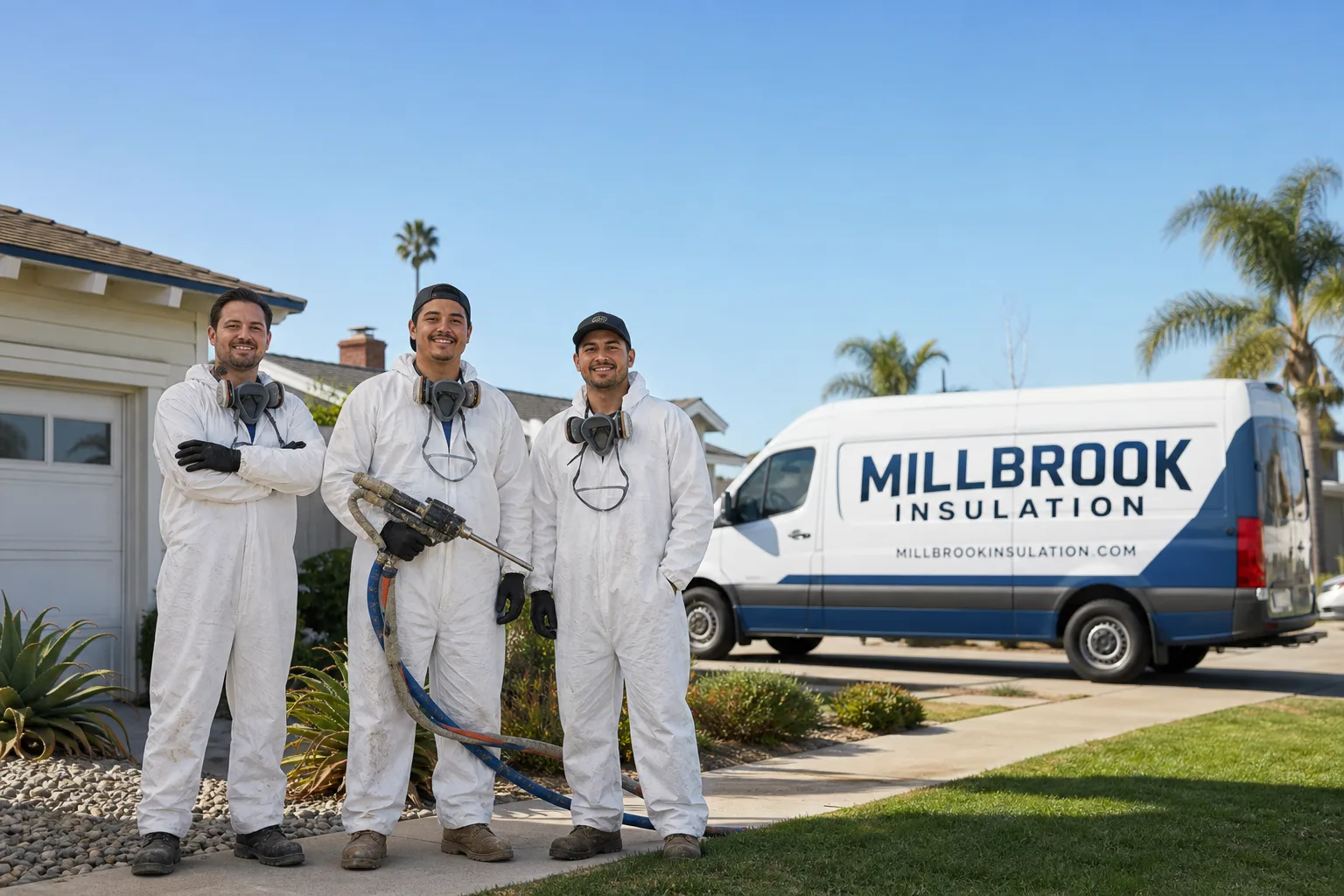
Our Attic Insulation team has spent years working these assemblies. We know what a 1990s recessed can looks like buried in a sloped ceiling, how tile roof hips complicate access, and why marine-layer moisture settles into unsealed penetrations. Reviews from San Joaquin Hills customers consistently point to the same thing: we diagnosed the real problem before recommending a product. Eight brands. One contractor. Built around building science.
Attic Mold Removal in San Joaquin Hills
Attic mold removal in San Joaquin Hills almost always traces back to the same root cause: warm, humid air getting trapped in a cathedralized ceiling assembly that was never detailed for marine-layer moisture. Homes off Newport Coast Drive and around the San Joaquin Hills ridgeline sit in the coastal influence zone, where cool overnight air and fog push moisture into any unsealed penetration. When a 1990s-era recessed can leaks conditioned air into a slope assembly, condensation forms, and mold follows. Removal here typically starts at $1,200 and runs to $3,500 depending on the affected area and whether we’re treating framing, sheathing, or insulation itself.
Where We Find It in These Homes
Slope assemblies along the south and west faces are the usual suspects. Afternoon sun drives heat into the roof deck, and when that deck is directly above living space with no vented channel, the temperature swing creates condensation. We commonly find mold around HVAC chases, unsealed can lights, and the knee-wall transitions common in second-story bonus rooms throughout San Joaquin Hills.
What Removal and Prevention Actually Entail
We treat the surface with appropriate antimicrobial agents, remove contaminated insulation, and then address the air-sealing defects that caused the moisture in the first place. Without the sealing step, the mold comes back. We also check for ember-intrusion points while we’re in the assembly, since this is a designated high-fire zone and any gap that lets moisture in also lets embers in during a wind event.
Attic Insulation Removal in San Joaquin Hills
Attic insulation removal in San Joaquin Hills is common when homeowners discover rodent damage, old compressed fiberglass batts that have slid out of place on sloped assemblies, or insulation that’s been soaked by a roof leak. Given how many tile-roof homes in the 92657 area have cathedralized ceilings, removal often means pulling batts out of slope cavities rather than vacuuming loose fill off a flat attic floor. Removal alone typically runs $900 to $2,400 in San Joaquin Hills, with the final price depending on access, the amount of material, and whether we’re hauling away contaminated or mold-affected insulation.
When Replacement Follows Removal
Most removal jobs turn into replacement jobs. That’s not an upsell – it’s just the reality of a home where the original insulation was never adequate for the thermal envelope. We walk homeowners through what we found and what the performance options are, from Rockwool batts in fire-sensitive assemblies to closed-cell spray foam where moisture control and air sealing are the priority.
Working Around the Architecture
Steep slopes and tile overhangs mean we stage carefully and protect roof edges. Tight driveways off San Joaquin Hills Road and alley-load configurations require planning, not shortcuts. We schedule removal work with enough time to do the detail work right, because a rushed retrofit on one of these homes just means someone else fixes it in five years.
Trusted Brands We Service in San Joaquin Hills
Millbrook carries and installs eight insulation brands, including Reflectix service in San Joaquin Hills, which is unusual for a contractor in this market. For San Joaquin Hills customers we lean on specific products for specific reasons: Rockwool mineral wool where wildfire ember resistance and acoustic performance matter, Icynene and Demilec spray foam systems where the job calls for open-cell or closed-cell depending on moisture and budget, and Owens Corning and GreenFiber where fiberglass or recycled cellulose make the most sense. We stock the materials and parts for these systems locally, so turnaround on a San Joaquin Hills replacement or upgrade does not drag.
Common Attic Insulation Problems We See in San Joaquin Hills Homes
- Non-IC recessed cans leaking air through cathedralized slope assemblies. The original 1990s fixtures in many of these homes were never designed to sit in an insulated ceiling cavity, so conditioned air escapes directly into the roof assembly or the living space. Insulation added around them without IC-rated airtight covers simply does not perform.
- Marine-layer moisture trapped in unsealed penetrations. Cool, damp morning air off the Pacific gets pulled into any gap around HVAC chases, vent pipes, and can lights. Once inside a cathedralized assembly with no drying path, it condenses and feeds mold growth along the south slope.
- Settled or slid batts on pitched roof decks. Fiberglass batts installed against a slope lose loft over time and slump away from the roof deck. Tile roofs make access tight, and crews who shortcut leave the assembly under-insulated where the afternoon sun hits hardest.
- Ember-vulnerable gaps in the wildland-urban interface. San Joaquin Hills backs onto open space with real wildfire exposure. Any gap that leaks air is also an ember entry point. Air sealing plus ember-resistant insulation is not a luxury here; it’s the difference between a defensible assembly and a liability.
Pricing for Attic Insulation in San Joaquin Hills, CA
You should know what to expect before anyone steps on your property. Blown-in attic insulation in San Joaquin Hills runs $1,800 to $3,200 for a typical cathedral-ceiling home where vents and recessed cans are already sealed. Batt insulation replacement runs $2,200 to $4,500 depending on slope complexity. A full top-up with air sealing and IC-rated can retrofits typically lands between $3,800 and $6,400, and attic insulation replacement with mold remediation or rodent damage can reach $7,500 on larger homes. Access, assembly condition, and material choice drive the final number. We provide free estimates, and Ken Albright reviews every San Joaquin Hills proposal personally.
We Also Serve Cities Near San Joaquin Hills
Millbrook Insulation handles Attic Insulation work throughout the coastal Orange County corridor. In addition to San Joaquin Hills, our crews regularly serve Newport Beach, Laguna Beach, Irvine, and Costa Mesa. If you’re in a neighboring community with a similar tile-roof or cathedral-ceiling home, the same diagnostic approach applies.
Serving San Joaquin Hills, CA — Our Local Coverage Area
We’re based in the San Joaquin Hills area and know this community well. Use the map below to see our service coverage — if you’re nearby, we can almost certainly help.
FAQs About Attic Insulation in San Joaquin Hills
Because in a cathedralized assembly, the ceiling touches the roof deck and there is no vented space to blow loose fill into, so insulation must be installed against the slope itself. That means air sealing around recessed cans, HVAC chases, and vents is the actual insulation job – adding material without sealing those penetrations is wasted effort. Call (833) 715-5062 and we’ll walk you through what your specific assembly needs.
Yes, and in a measurable way. Cool, moist air from the coastal marine layer gets pulled into unsealed ceiling cavities every morning, and when that moisture condenses inside a slope assembly it degrades insulation R-value and feeds mold. Homes in San Joaquin Hills’s higher elevations get less fog than lower Newport Beach, but the ridgeline homes still see enough marine influence to require air sealing as part of any insulation retrofit.
We require IC-rated airtight fixtures or retrofit covers before insulation goes in around any recessed can, because the original 1990s cans in San Joaquin Hills homes leak air directly through the sloped ceiling. We seal each can with fire-rated materials and then insulate around it using the material appropriate for your assembly and wildfire exposure. This step is non-negotiable in our process.
Yes, Rockwool mineral wool is our go-to for San Joaquin Hills slope assemblies because it’s non-combustible, resists ember ignition, and provides excellent thermal performance in both hot and cool conditions. It also adds real acoustic isolation, which matters in hillside homes where sound carries. We carry Rockwool for exactly these applications, and we’ll tell you frankly when it’s the right call or when something like Demilec closed-cell foam makes more sense for your moisture conditions.
They affect staging and access more than total timeline. We plan San Joaquin Hills jobs around driveway width, equipment placement, and roof edge protection, and we build in time for careful air-sealing detail rather than rushing through it. A typical cathedral-ceiling retrofit still lands between one and two days, but we will walk you through any access constraints before we schedule. For an exact schedule and a free estimate, call (833) 715-5062.
Written by Ken Albright, Owner at Millbrook Insulation, serving San Joaquin Hills and coastal Orange County.