
Spray Foam Insulation in Irvine, CA: What It Costs and How It Works Here
Spray foam insulation in Irvine typically costs $2,800 – $7,500 for a full attic job and $1,800 – $4,200 for wall cavity injection, with most homes in the 92618 and 92620 zip codes falling in the middle of that range. The price swings on whether you need open-cell or closed-cell foam, how accessible your attic or wall cavities are, and whether your HOA requires interior-only access. We complete most Irvine spray foam jobs in one to two days, and we route every installation through attic hatches or interior wall ports so nothing changes on the outside of your home.
If you’re comparing spray foam against fiberglass batts or blown-in cellulose, you’re already asking better questions than most contractors expect. The honest answer: spray foam earns its cost in Irvine when you’re fighting heat gain through a 140°F attic or trying to quiet a shared wall in an attached townhome. We stock Spray Foam Insulation systems from Icynene and Demilec, and we’ll tell you plainly when foam is the right tool and when it isn’t. Call us at (833) 715-5062 for a straight answer and a free estimate.
Fast, Reliable Spray Foam Insulation Across Irvine
We work in Irvine every week, from the 1970s tract homes off Culver Drive to the newer builds stacked around the Irvine Spectrum. You don’t need a contractor who has to look up your zip code. You need someone who knows that a Woodbridge townhome off El Camino Real has a completely different insulation profile than a 2010s single family house in Portola Springs. We’ve crawled through enough Irvine attics to know what the original builder left up there, and what’s failed since.
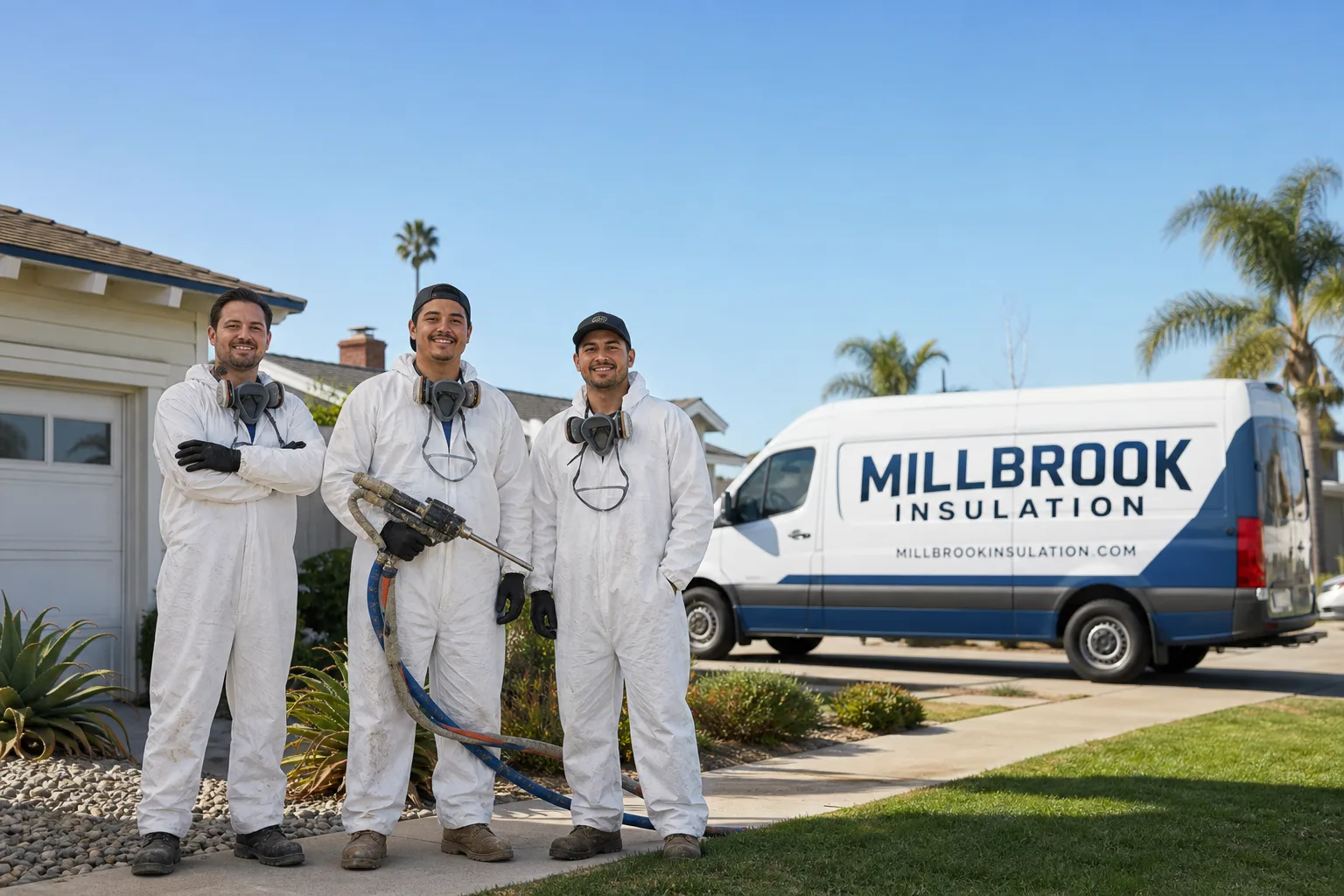
Ken Albright leads our crews, and he’s built the company around a simple habit: diagnose first, then recommend. That’s why we carry eight insulation brands and three installation methods. When we show up in Irvine, we’re not there to sell you one product. We’re there to match the product to what your house actually needs. Call (833) 715-5062 and we’ll schedule a walk-through that starts with questions, not a quote sheet.
Why Millbrook Insulation Is Irvine’s Preferred Spray Foam Insulation Company
Most insulation contractors in Orange County work with one or two product lines and then spend the whole sales conversation defending that narrow inventory. We don’t have that problem. Millbrook Insulation carries Icynene and Demilec spray foam, Rockwool mineral wool, Owens Corning fiberglass, and GreenFiber recycled cellulose. Eight brands. One contractor. That means when we recommend closed-cell foam for your rim joists, it’s because the moisture profile justifies it, not because it’s the only thing on the truck.
Irvine homeowners call us because the diagnosis leads the conversation. A Woodbridge townhome with single-pane aluminum windows and no cavity fill on the party wall needs a different approach than a 2005 Westpark house with settled R-30 fiberglass in the attic. We’ve done both, many times. Our crews know the HOA rules in the villages, they know which attics run hot and which crawlspaces run damp, and they don’t ask you to sign off on exterior changes that will get flagged by your architectural review board.
Spray Foam Attic Insulation in Irvine
Spray Foam Attic Insulation in Irvine addresses the single biggest thermal problem this city creates: attics that regularly hit 140°F or more from May through October. That heat radiates down through your ceiling drywall all afternoon, and your AC runs harder just to hold the thermostat. A full open-cell or closed-cell application across the attic deck seals the air leaks and cuts that radiant load dramatically. In Irvine, a typical attic spray foam job runs $2,800 – $7,500 depending on square footage and foam type.
Open-Cell on the Attic Deck
For most Irvine homes, open-cell Demilec on the underside of the roof deck is the right call. It air-seals the attic, knocks down the heat gain, and costs less than closed-cell. The caveat: open-cell needs the attic to stay reasonably dry, and Irvine’s coastal-influenced air usually cooperates except in the June gloom stretch.
Closed-Cell for Attic Storage or Ductwork Areas
When the attic doubles as storage, or when HVAC ducts run through unconditioned space, we lean toward closed-cell Icynene. It adds structural rigidity and a vapor barrier in one pass. It costs more per board foot, but in a hot Irvine attic it pays back through lower cooling bills.
Spray Foam Wall Insulation in Irvine
Spray Foam Wall Insulation in Irvine usually means injecting foam into existing wall cavities through small interior holes, not tearing out drywall. That’s the method we use most in older Woodbridge and El Camino Real homes where the original builder skipped wall insulation entirely or used thin R-13 batts that have compressed over 30-plus years. Wall cavity injection in Irvine typically runs $1,800 – $4,200 depending on the number of exterior walls and access.
Interior Injection Without Exterior Changes
We drill small access ports from inside the house or through the attic, inject the foam, and patch the ports to a smooth finish. Nothing on the outside of your home changes. No new penetrations, no altered siding profiles, nothing for the HOA to photograph and flag.
Party Wall Sound and Fire Treatment
Attached townhomes in Westpark and Woodbridge share walls with neighbors. Those walls are often empty cavities in older builds, which is why you hear kitchen cabinets closing next door. Closed-cell foam brings both sound deadening and a fire-rated assembly when paired with the existing drywall.
Trusted Brands We Service in Irvine
We don’t push one manufacturer. We carry Icynene and Demilec spray foam because they’re professional-grade systems that perform differently and we want both options available for Irvine conditions. Demilec open-cell handles the hot attic air-sealing work at a lower cost. Icynene closed-cell handles rim joists, crawlspaces, and wall cavities where moisture or structural strength matters. We also stock Owens Corning and GreenFiber for homes where fiberglass batts or recycled cellulose make more sense than foam. The product follows the diagnosis, not the other way around.
Common Spray Foam Insulation Problems We See in Irvine Homes
- Builder-grade R-13 walls and R-30 attics that never met Title 24. Irvine homes from the 1980s and 90s were built to code minimums of their era. Those attics are now dust bowls of settled fiberglass and those walls are thermal sieves on hot afternoons.
- HOA restrictions blocking ventilation upgrades. Proper spray foam attic work sometimes wants a new vent or soffit change. In Irvine, that triggers architectural review. We plan interior-only strategies from the start so you never have to file a variance.
- Shared townhome walls with no cavity fill. We see this constantly in Woodbridge and Westpark. The original build put two layers of drywall on a shared frame and called it done. Neighbor noise and heat bleed straight through.
- Foam sprayed in a 140°F attic without surface prep. Closed-cell foam hates a dusty, hot substrate. It won’t bond right, it off-gasses longer, and homeowners complain about the smell. We pre-cool or schedule around peak heat, and we clean the deck first.
Pricing for Spray Foam Insulation in Irvine, CA
Here are the numbers we actually quote in Irvine. Attic spray foam: $2,800 – $7,500 for a typical single family home. Wall cavity injection: $1,800 – $4,200 for exterior walls with interior access. Rim joist work in crawlspaces: $800 – $1,800 for most Irvine homes. Garage ceiling spray foam: $1,200 – $2,900 depending on whether it’s a finished garage or exposed joists. Closed-cell runs higher than open-cell everywhere in the city, and homes in the 1970s tracts off Culver and Walnut tend to need more prep work than newer Portola Springs builds. The estimate is free. Call (833) 715-5062 and we’ll give you real numbers after a walk-through, not a guess over the phone.
We Also Serve Cities Near Irvine
Our crews run routes through Irvine and the surrounding cities weekly. If you’re in Tustin, Santa Ana, North Tustin, or San Joaquin Hills, you’re on our regular schedule. We know the HOA rules in the Irvine villages and the older housing stock in the surrounding areas. Call (833) 715-5062 and we’ll get you on the calendar.
How Irvine’s HOA and Architectural Review Rules Shape Spray Foam Work
Irvine’s master-planned villages run two layers of approval: city code plus each village’s architectural review board. That second layer is the one most insulation contractors never think about until a homeowner gets a violation notice. Any new attic vent, roof jack, or soffit penetration visible from the street can trigger a review, a delay, and sometimes a demand to reverse the work. So we don’t go there. We route all foam work through attic hatches, interior wall ports, and existing penetrations. Your roof line, your soffits, your window trim: all untouched. The foam goes in, the performance goes up, and the street view doesn’t change one bit. That’s the only way spray foam makes sense in Irvine.
This matters especially in the older villages like Woodbridge and the El Camino Real corridor, where single-pane aluminum windows and original siding are protected by design guidelines. You can’t just punch a hole in the stucco and patch it. The patch shows. So we inject from inside. In one Woodbridge attached townhome off El Camino Real, our crew found original 1980s fiberglass batts settled to roughly half depth in the attic and zero wall cavity fill on the shared party wall. Neighbor noise and afternoon heat poured straight through. We injected closed-cell Icynene from interior wall ports and open-cell Demilec across the attic deck, working entirely from the interior so the single-pane aluminum windows and HOA-controlled trim stayed untouched. We tied the party-wall assembly back to a fire-rated profile. The homeowner told us the second-story rooms held temperature through the 100°F-plus August afternoons without touching the facade. That’s the job, done the Irvine way.
Serving Irvine, CA — Our Local Coverage Area
We’re based in the Irvine area and know this community well. Use the map below to see our service coverage — if you’re nearby, we can almost certainly help.
FAQs About Spray Foam Insulation in Irvine
No, if the right contractor plans for it. We route all attic foam work through the existing attic hatch and interior access points, so we don’t add new roof jacks, soffit vents, or any penetration visible from the street. Your HOA never sees a change. For homes where the foam itself creates a ventilation redesign need, we work within the existing roof profile.
Yes. We inject foam from interior wall ports or from the attic down into wall cavities. The drywall gets patched and painted after. The stucco, siding, window trim, and everything visible from the street stays exactly as it is. That’s the standard method for Woodbridge and older El Camino Real homes where the HOA guards the exterior design closely.
Yes. Shared walls in Irvine townhomes are fire-rated assemblies, and when we insulate or re-insulate a party wall, we use closed-cell foam or a fire-rated barrier to maintain that rating. Your HOA’s architectural review board won’t require you to document it every time, but the building code does, and we don’t cut that corner.
It won’t make it silent, but it will make a significant difference. Closed-cell foam in an empty party wall cavity fills the void, dampens mid-to-high frequencies, and cuts the hollow drumming that makes shared walls feel like paper. For serious acoustic separation, Rockwool mineral wool is often the better choice, and we stock that too.
R-13 in the walls and R-30 in the attic were the code minimums for a different era. In Irvine’s climate, with attics hitting 140°F and afternoon sun on every west-facing wall, those numbers translate to an AC system cycling hard all afternoon. Spray foam, especially air-sealing at the attic deck, cuts that load noticeably. Call (833) 715-5062 for a free estimate and we’ll show you where your home is losing the most.
Written by Ken Albright, Owner at Millbrook Insulation, serving Irvine and Orange County with diagnostic-driven insulation since day one.